

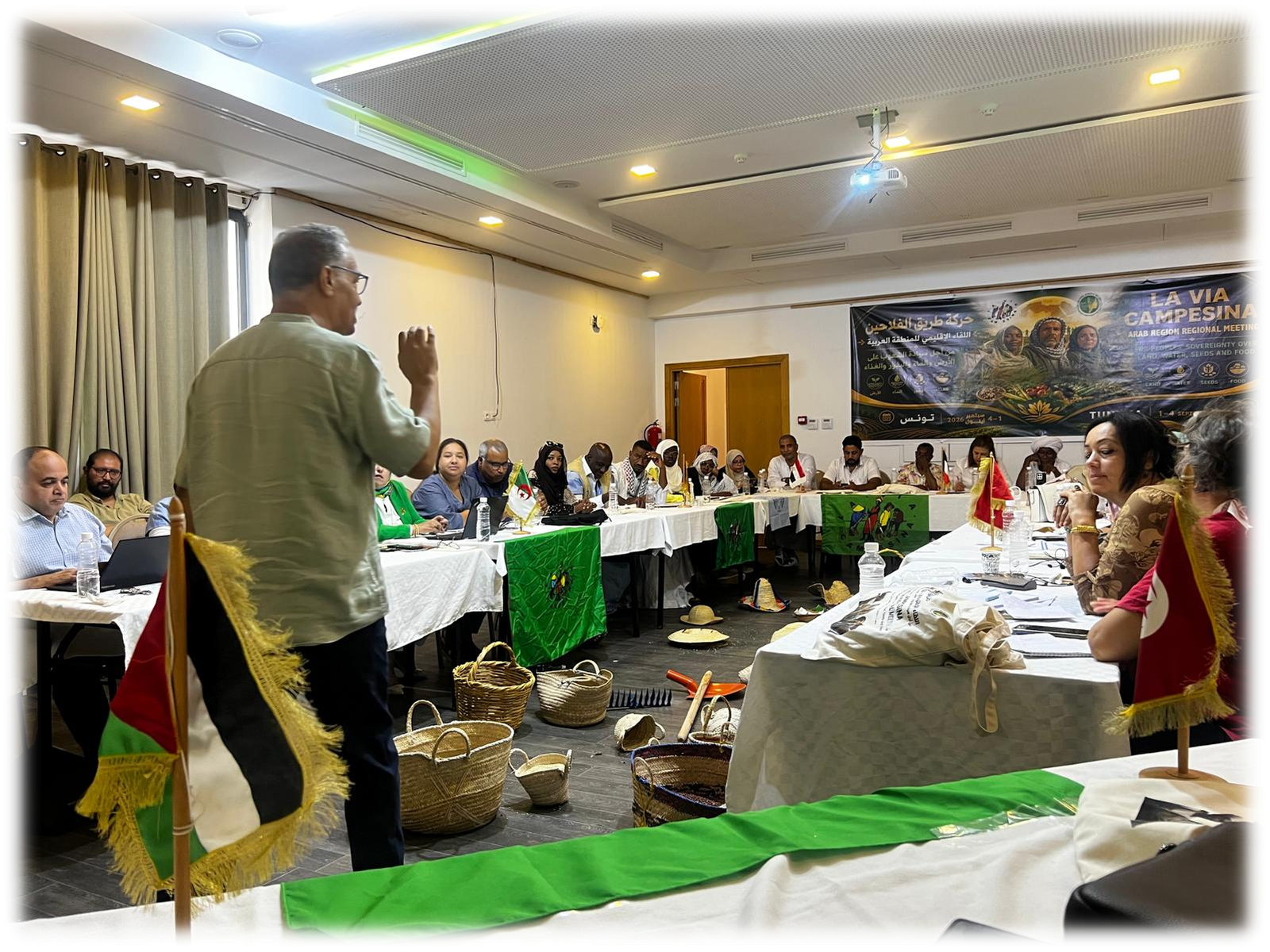
An analytical reading of the outcomes of the Regional Meeting on Agroecology and Public Policies – Arab Region, Tunisia, 1–4 September 2026
In a hall in Tunisia, peasant women and men from eight Arab countries spent four days discussing who has the right to decide how the land is cultivated, for whom, and at what cost. This is the distinction that makes the Regional Meeting on Agroecology and Public Policies, held by La Via Campesina Arab Region in Tunisia from 1 to 4 September 2026, a moment that deserves a deeper reading than limiting its outcomes to a final declaration, and one that goes beyond classifying it as part of a series of regional meetings that Arab agricultural organizations have grown accustomed to over decades.
What took place in Tunisia cannot accurately be described simply as a meeting on agroecology so much as an attempt, still in the process of taking shape, to redefine the position of the Arab peasant: from a recipient of agricultural development projects to a decision-maker within them, and from a scattered presence within a global peasant movement to a regional political space with its own discourse and priorities. The question that deserves to accompany any reading of what emerged from Tunisia is: what is actually changing in the Arab peasant movement, and can this meeting be considered a sign of that transformation, or merely another stop in a long record of meetings that do not alter the balance of power?
The Arab region entered the recent decades of its agricultural history burdened with a complex legacy: rural development programs funded by successive international actors, non-governmental organizations that learned the language of projects and donors more than they learned the language of grassroots organizing, and peasants whom official policies often treated as production figures rather than as rights-holders in the land they cultivate. The Tunis Declaration does not erase this legacy, but it reads it critically when it distinguishes, even implicitly, between an organization that manages projects and a movement that builds peasant decision-making power. This distinction, as will become clear later, is the key to understanding why the meeting document insists on the language of public policy, sovereignty, and decision-making, rather than the language of services, assistance, and technical support to which a large part of the development sector in the region has become accustomed.
Who Holds the Decision: The Peasant Question as a Question of Power
For decades, the agricultural question in the Arab region was framed primarily as a question of production: how to increase yields, how to improve productivity, and how to introduce newer technologies into a field assumed to be lagging behind agricultural modernity. The declaration issued in Tunisia breaks this framework at its roots. Food sovereignty, as stated in the meeting text, does not merely mean increasing production, but rather the right of peoples to determine their agricultural and food systems, and the right of peasants to land, water, seeds, knowledge, organization, and markets. This represents a shift in the very location of the question: the question is no longer “how do we grow more?” but “who decides what we grow, how, and for whom?”
Who owns the land, water, and seeds? Who determines agricultural policies? Who decides what is grown and for whom? And who bears the environmental and social cost of an agricultural model built, to a large extent, on dependency on inputs and exports? These questions are not a theoretical backdrop to the Tunisia meeting; they are the substance upon which the entire declaration was built. The shift from “food security,” as a quantitative objective measured by the availability of food, to “food sovereignty,” as a right to determine the destiny of the food system, is a shift in the position of the peasant himself: from a beneficiary of a policy formulated above him to a rights-holder in shaping it. The difference is not linguistic; food security can be achieved through imports, aid, or large agricultural corporations that control the entire food chain, whereas food sovereignty can only be achieved when decisions over land, water, and seeds are in the hands of those who live from them.
This new position of the peasant—as a rights-holder rather than a beneficiary—is the thread connecting every section of the declaration: from land and water, to public policies, to the position of women and youth, to Palestine and Sudan, and to the position of the Arab region within the global peasant movement.
Agroecology: Who Owns Legitimate Knowledge?
When discussing agroecology, it is easy to slip into presenting it as a package of environmental practices: reducing chemical inputs, diversifying crops, and conserving soil. But the declaration issued in Tunisia explicitly rejects this reduction and describes agroecology as a pathway of social, environmental, and political transformation, not a package of ready-made techniques or a short-term project. The difference between these two descriptions is not stylistic: a package of techniques is taught and transferred from the outside inward, whereas a process of transformation is built from within, from the peasant’s experience, land, and local climate.
Here lies the importance of what the meeting described as the region’s “rich, though uneven and threatened” body of knowledge and experiences related to seed conservation, water management, soil conservation, rainfed agriculture, pastoralism, agricultural diversity, and integrated systems. This body of knowledge was not framed in the declaration as folkloric heritage worthy of documentation, but as a knowledge base upon which to build: building Arab agroecology, as the declaration states literally, “does not begin from zero, but from reclaiming this knowledge, developing it, and linking it to participatory research, peasant organizing, and contemporary experiences.” In other words, the peasant here is not an object of study, but a partner in participatory research, and this marks a fundamental difference from the traditional agricultural extension model that places the expert above and the peasant below.
This logic is embodied in the commitment to build a regional framework for peasant agroecology schools, based on peasant-to-peasant learning, on producing knowledge from the field and experience, and on building leadership and organization alongside skills. The school here is not a training center that produces peasants with greater technical skills, but what the declaration described as a “living space for producing and defending knowledge.” Defending knowledge is a political act as much as an intellectual one: whoever has the right to define “correct agricultural knowledge” possesses symbolic power no less important than the power of those who own the land. When peasant schools become the ones producing this definition, rather than agricultural universities, input companies, or donor programs, a transformation has taken place in the position of knowledge itself, not merely in agricultural methods.
This approach places the peasant in a position entirely different from his usual position in official agricultural extension programs, where the agricultural engineer or international expert stands in the position of the one who possesses the solution, while the peasant stands in the position of the one who implements or resists it. When peasant schools are based on the principle of horizontal learning—peasant to peasant—they dismantle this hierarchy: the experience accumulated by a peasant in managing limited water resources, or in preserving a local seed variety that has resisted drought for generations, becomes recognized knowledge, rather than merely “traditional knowledge” viewed as a stage that must be surpassed on the way toward “agricultural modernity.” This is precisely what makes the declaration’s discussion of “reclaiming knowledge” closer to a political position on who has the right to define knowledge, rather than mere nostalgia for ancestral practices.
Land, Water and Seeds: From Right to Commodity
Nothing in the final declaration summarizes the meeting’s position on natural resources more clearly than three short consecutive sentences: water is a right, not a commodity; land is the basis of life, not a financial asset for speculation; and seeds are a living heritage developed by generations of peasants, not a commercial input subject to monopolization. These sentences, despite their apparent simplicity, encapsulate a prolonged struggle in the Arab region between two opposing ways of understanding resources: the logic of collective rights, which links land, water, and seeds to survival, memory, and continuity, and the logic of the commodity, which transforms these resources into assets that can be monetized, speculated upon, and exported.
When the declaration moves from the general to the specific, the struggle becomes tangible: it notes with concern what agricultural lands in Morocco are witnessing in terms of land grabbing that “takes them away from small-scale peasants and transforms them into large estates resembling feudal holdings,” turning them “from land producing people’s sustenance into land directed toward export and speculation.” Although limited to two lines, this reference points directly to a recurring pattern in more than one Arab country: land that once produced food for local communities is transformed, through large-scale investment mechanisms, into land producing for distant markets, while those who once lived from it lose the possibility of accessing it or even working on it under dignified conditions. The paradox is that this transformation is often presented in the language of development, investment, and attracting capital, rather than in the language of dispossession.
From this specific example, the declaration moves to a public-policy demand: protecting agricultural lands from indiscriminate grabbing and speculation, ensuring equitable access to and management of water, safeguarding peasants’ right to save, select, and exchange seeds, and supporting biodiversity and local agricultural systems. This movement from diagnosis to political demand is what distinguishes the meeting’s discourse from the discourse of complaint: it does not merely describe land grabbing, but identifies what has the authority to stop it—public policy—and demands that it be moved in the opposite direction.
Seeds, in this sequence, are no less important. When their monopolization is described as transforming a “living heritage developed by generations of peasants” into a “commercial input,” the issue goes beyond protecting a particular plant variety to protecting a historical relationship between peasants and their seeds: seeds they selected, developed, and exchanged with their neighbors over generations, versus seeds purchased seasonally from a company under intellectual property conditions that prevent replanting or exchange. When the meeting calls for safeguarding peasants’ right to save, select, and exchange seeds, it is, in practical terms, defending the continuation of this relationship against formal seed systems that tend, in more than one Arab country, to favor commercially registered varieties at the expense of local varieties.
Climate: The Question of Who Pays the Price
The final declaration goes beyond the usual formulation that presents climate change as an external threat affecting agriculture, as though climate and agriculture were two separate subjects that happen to intersect. Instead, the meeting directly links the climate crisis to indebtedness, dependency, and prevailing development and energy policies, placing it within the broader context of the political economy that produced this crisis in the first place: a development model burdened by debt, dependent on exporting resources to repay it, and reproducing dependency rather than breaking it.
More dangerously, according to the declaration, is what may happen under the guise of confronting this very crisis: an explicit warning against “turning climate action and the energy transition into a new gateway for grabbing land and resources under green labels,” or into large-scale projects that exclude peasants and local communities from decision-making and benefits. This is a precise political critique of what is globally known as “green grabbing”: wind farms, solar panels, or carbon projects established on agricultural or pastoral lands, financed through climate funding and framed in the language of sustainability, while the communities that lived on these lands are excluded from any benefit or decision. The question implicitly posed by the declaration is: who owns the green transition? Who benefits from it? And who pays its price when it becomes another investment project instead of a project of justice?
The answer proposed by the meeting is not a rejection of climate transition, but a condition for its legitimacy: a just transition that begins with rights, strengthens the ability of peasants and communities to remain and produce, and places social and peasant justice at the heart of climate justice. In other words, there is no climate justice without peasant justice, and no credibility for any climate discourse that ignores who owns the land on which the projects of the “solution” will be established.
From Project to Policy
One of the most significant threads in the Tunis Declaration is the shift from the logic of the project to the logic of public policy. Over decades, the Arab region has witnessed hundreds of agricultural projects funded by international and local actors, some of which achieved genuine localized successes. But the declaration points, even if implicitly, to a recurring paradox: a small project may succeed in a village or area, while agricultural policy itself—policies of subsidies, investment, research, extension, water management, and markets—continues to reproduce the same marginalization on a broader scale. The project treats a localized symptom; policy produces the structural disease.
Hence the declaration’s explicit call to review systems of subsidies, investment, research, agricultural extension, water management, seed policies, and markets, in a way that shifts priority from an input-intensive production model toward supporting small-scale peasants, agroecology, and food sovereignty. This means that a movement succeeding in this direction does not measure its success by the number of beneficiaries of a particular project, but by the extent of its ability to change “the rules that produce reality”—the systems that determine who receives support, who gains access to credit, which seeds are officially approved, and which agricultural model public policy rewards.
This logic is reflected practically in the commitment to transform the national consultations presented by delegations during the meeting into an ongoing process for building shared Arab peasant programs capable of influencing national, regional, and international policies. A national consultation, if confined to a regional meeting, becomes a consultative ritual without impact; but if transformed into a cumulative process that feeds shared political agendas, it becomes a tool for building power, not merely collecting opinions.
This explains the importance of bringing these consultations to a unified regional level rather than keeping them confined to their national contexts: Egypt, Tunisia, Morocco, Sudan, Palestine, and other countries in the region face, each with its own local particularities, the same pattern of challenges—the decline of support directed toward small-scale peasants, the dominance of export chains over agricultural policy, and weak participatory agricultural research. When these national experiences accumulate into unified regional programs, they acquire negotiating weight before governments and international institutions that no individual country possesses on its own, and the demand to review subsidy, research, and extension policies becomes a coordinated regional demand rather than scattered national appeals that can easily be ignored one by one.
Women and Youth
Strikingly, the final declaration avoids the term “empowerment,” which usually dominates development discourse concerning women and youth. Instead, it frames the issue entirely differently: “As long as women and youth remain on the margins of decision-making, there can be no genuine ecological transformation and no strong peasant movement.” This formulation transforms the presence of women and youth from an “accompanying social issue” into a condition for the integrity of the entire political project. The issue, as the declaration frames it, is not the number of women participating in meetings or their percentage in programs, but who decides, who owns land, water, and financing, and whose agricultural knowledge is recognized as legitimate knowledge.
The declaration is clear in this distinction when it describes women as “food producers and bearers of knowledge, seeds, and agricultural memory,” not as a vulnerable group requiring special support, but as essential knowledge-producing and productive actors whose participation must move “from numerical representation to actual leadership, decision-making, knowledge production, and access to land, water, financing, and organization.” This difference—between presence in the meeting room and presence in the decision-making room—is at the heart of the critique implicitly directed by the meeting toward decades of “rural women’s empowerment” programs that often settled for symbolic representation without touching relations of ownership and actual power.
As for youth, the declaration links them directly to the dilemma of the continuity of agriculture itself: without young people who have a future on the land, agriculture has no future, and migration from rural areas—rather than renewal within them—becomes the norm. When the declaration places migration, displacement, the decline of rural livelihoods, and the rights of women and men agricultural workers within the issue of food sovereignty itself, it refuses to separate these issues from one another: there can be no discussion of food sovereignty while young people leave rural areas because they see no future there, and while seasonal and migrant agricultural workers are left outside any social or trade-union protection.
Palestine: Where Land, Colonialism and Survival Intersect
Palestine’s presence in the Tunis Declaration does not appear as a separate solidarity paragraph that could be removed without affecting the rest of the text; rather, it appears as the most acute case of everything the declaration discusses in its other sections concerning land, water, and sovereignty. When the meeting speaks of land as the basis of life rather than an asset for speculation, and of water as a right rather than a commodity, Palestine makes these principles tangible in their harshest forms: land is confiscated, water is cut off or diverted, and agriculture is targeted as a means of survival, not merely an economic activity.
The declaration renews its “absolute and unconditional solidarity with the Palestinian people, its peasant women and men, in their struggle for land, water, freedom, and dignity, and in confronting occupation, settlements, the seizure of resources, displacement, and the destruction of the foundations of life and agricultural production.” More important than the formulation of solidarity itself is the framework in which it is placed: defending the Palestinian peasant’s right to remain on their land, cultivate it, and access their water and seeds is “an integral part of the global peasant movement’s struggle for food sovereignty and peoples’ rights.” In this way, Palestine does not become a political issue “outside” the agricultural question to which solidarity is added, but rather the test that reveals whether the concept of food sovereignty is serious or merely a slogan: if food sovereignty means peoples’ right to their land, water, and seeds, then the forcible removal of that right through military occupation and settlement is its clearest form of violation.
This is what gives Palestine’s position in the Tunis Declaration its weight: it is not an exceptional case separate from the discussion of land, water, and seeds that occupied the meeting throughout its days, but rather the point at which all these issues intersect simultaneously and with the greatest intensity. When the declaration rejects “all forms of occupation, colonialism, and wars that use land, water, and food as tools of domination, uprooting, and starvation,” it is not merely issuing a general political position, but linking the experience of the Palestinian peasant specifically to the experience of every peasant in the region who sees their land and water threatened by other forms of dispossession, even if those forms are less violent and visible.
Sudan: Agriculture as a Condition for Society’s Survival
In Sudan, agriculture is not presented as a struggling economic sector, but as a direct arena of struggle over the continuation of life itself. The declaration renews its full solidarity with the Sudanese people “in their ordeal under the weight of war,” and affirms its support for relief through agricultural work and for assisting farmers in continuing production under these harsh conditions. But what matters most is the form this support takes: not a general humanitarian statement, but renewed specific support and solidarity with the initiative of the Gezira and Managil Farmers’ Alliance in its campaign to support the cultivation of the largest possible area, because of its direct impact in alleviating the severity of famine for the Sudanese people.
This specificity is significant: when the state and its institutions collapse under the weight of war, the ability of farmers themselves to organize and cultivate the land becomes an act of social resistance as much as an agricultural activity. Solidarity here is not with “victims” in the humanitarian sense, but with agricultural actors trying, amid war, to keep the land productive and society capable of feeding itself.
From a Scattered Presence to a Regional Political Space
Perhaps the most important element that does not appear under a direct heading in the declaration, but runs throughout its structure, is the transformation in the way the Arab region is present within La Via Campesina. The global peasant movement includes dozens of organizations from different continents, while Arab participation in it has historically been closer to the presence of scattered national organizations meeting at international conferences without necessarily forming a unified regional position. What the Tunis Declaration documents is an attempt to change this equation: building a “more cohesive, present, and effective Arab region” within the movement, based on grassroots peasant organizing, democracy, and autonomy.
This transformation has concrete mechanisms, as stated in the declaration: the national consultations presented by delegations during the meeting are not an end in themselves, but raw material that, through an ongoing process, is transformed into shared Arab peasant programs. Agroecology schools are not merely a training tool but, as we have seen, a mechanism for producing shared regional knowledge capable of serving as the basis for a unified political position. And when the declaration emphasizes the importance of an “organized and effective Arab presence” at La Via Campesina’s Mid-Term Conference in Thailand, it indicates that the goal is not merely symbolic “presence” in the global movement’s activities, but the representation of a clear regional position regarding land, water, seeds, climate, food sovereignty, and peasants’ rights.
What gives this process its particular character is that the Arab region does not enter the global peasant movement with a blank page, but with an intensely dense historical and political experience: occupation and settlement in Palestine, war in Sudan, transboundary water crises, indebtedness, migration, sharp rural-urban inequalities, and land grabbing in more than one country. This particularity is not a burden weighing down Arab participation in the global movement, but, if articulated politically, an asset that gives the region a distinctive voice within a global debate on food sovereignty and climate justice.
La Via Campesina’s Mid-Term Conference in Thailand, to which the declaration refers, is not merely an organizational stop on the agenda of the global movement; when the Arab region arrives with a unified position built through national consultations, peasant schools, and an extended regional discussion, it arrives as an actor with its own agenda, not as a group of delegations listening to priorities formulated in other regions of the world and then joining them later. This is the essence of the difference between “representation” and “building”: representation is satisfied with sending a delegate who carries a voice, whereas building assumes that this voice is the product of an internal political process that required real time and organizational effort, as reflected in the steps preceding Tunisia itself and the commitments that followed it.
A Peasant Movement, Not a Development Organization
The distinction suggested by the logic of the declaration deserves particular attention: the difference between being an agricultural development organization, a network of organizations, or even a lobby defending the interests of the agricultural sector, and being a peasant movement. A development organization implements projects and provides services to beneficiaries. A network coordinates among independent members without necessarily producing a unified political position. A lobby defends a narrow sectoral interest before decision-makers. A peasant movement, as its contours appear in the Tunis Declaration, assumes something fundamentally different: a peasant base that organizes itself democratically, produces its own knowledge and positions, and engages in a political struggle over who owns land, water, seeds, and decision-making power—not merely over who receives a service or funding.
This difference appears in the declaration’s vocabulary itself more than in any direct statement: the shift from beneficiary to rights-holder, from project to policy, from training to knowledge production, from coordination to building collective power, and from symbolic solidarity to joint political action. When the Arab region describes itself as part of a global peasant movement, rather than as a partner or beneficiary of its programs, it places itself in an entirely different position vis-à-vis states, donors, and markets: the position of one who negotiates and struggles, not one who begs or implements.
Who Produces the Narrative of the Countryside?
The final declaration makes a clear commitment to developing media, digital engagement, and regional publications as part of building the movement’s political and knowledge power, and to producing knowledge rooted in peasants’ voices, experiences, and struggles, “so that peasants are producers of knowledge, not subjects of it.” Although brief in the text of the declaration, this commitment carries greater political weight than it may initially appear. Historically, the Arab countryside has largely been a subject written about by others: academic researchers, development experts, passing journalists, and international institutions issuing reports about the “Arab peasant” without the peasant participating in formulating the question in the first place. Those who do not tell their own story have it told about them, often in a language that does not resemble their experience.
When the movement places knowledge production and media at the heart of its strategy, alongside agroecology schools and national consultations, it acknowledges that building political power is achieved not only through organizing on the ground, but also through who holds narrative power: who decides what the “agricultural problem” is, who the “model peasant” is, and which solutions appear “realistic” and which appear “idealistic.” When peasants themselves become producers of this narrative, rather than merely sources of data for reports written by others, their position in the entire political equation changes.
What Comes After Tunisia?
The question that deserves to be asked after reading the Tunis Declaration is not whether its language is ambitious—it clearly is—but whether this ambition can be transformed into sustainable political and social power, or whether it will remain confined to a well-written text. The answer to this question does not lie in Tunisia itself, but in what follows: will agroecology schools move from a written commitment to an actual network that produces leadership and knowledge on the ground? Will the national consultations be completed and genuinely transformed into shared regional priorities capable of influencing concrete policies? Will the commitment to women’s and youth leadership translate into actual change in who gains access to land, financing, and organization, or will it remain at the level of formulation?
What gives the Tunis Declaration initial credibility is that it does not merely list principles, but links them to specific, trackable pathways: a regional framework for agroecology schools, national consultations transformed into shared priorities, public policies actually reviewed in the areas of subsidies, research, extension, water, seeds, and markets, organized participation in the global movement’s activities, and a regional media and knowledge strategy. These pathways give observers of the next phase clear criteria for measuring whether the Arab region has actually transformed, or whether Tunisia will remain a passing stop in a long history of meetings that issue strong declarations without changing the balance of power in the field.
There is an even more specific criterion that any observer can use to measure the seriousness of this process in the coming months: when issues of land, water, and seeds are raised in other national or regional forums, will they be transformed into specific policy demands bearing the signature of the Arab region as a whole, or will each country continue to fight its battles separately as it has traditionally done? And will the impact of agroecology schools appear in national agricultural policy discussions, or will their impact remain confined to the fields in which they were established? The answers to these questions—not the language of the declaration itself, however precise—will determine whether Tunisia has indeed constituted a turning point.
What is clear, however, is that the Arab region within La Via Campesina is no longer content with remaining on the margins of the global movement. Through a process that begins with local peasant schools and does not end with unified regional political positions, it is attempting to forge a different position for itself: not as a region that receives agricultural development models from outside, but as an actor that produces its own experience, knowledge, and political position, starting from land laden with a history of occupation, war, drought, and steadfastness, and from a body of peasant knowledge that never began from zero.